A less than in-depth look at depth

Media

Mentally I’m standing at a chalkboard writing again and again “3D is not a gimmick. . .3D is not a gimmick.”

Before Oculus Rift or Avatar, 3D to me meant red and blue blurry videos and the one 3D Spy Kids movie where the kid reaches his arm out into your face and it the previews showed audiences leaping out of their seats and throwing up popcorn in surprise and delight.
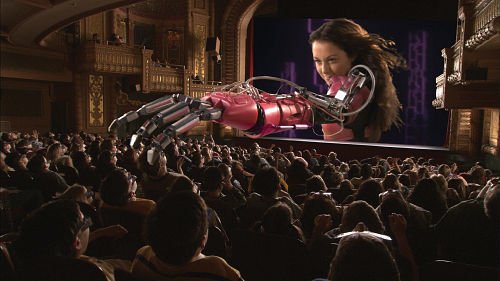
Someone left their cell phone and had to be punished. Credit: imdb.com

Someone left their cell phone on and had to be punished. Credit: imdb.com

But while I was a child watching children’s movies, some very smart people were doing some very smart things with 3D and were even kind enough to write guides so even people like me can know what what is going on. Or at least know what they’re called.

That red and blue 3D I mentioned before, for instance, is called an “anaglyph.” In this method of 3D, two differently colored images are laid on top of each other to make one picture and each eye only sees one color. And then 3D happens. So I still don’t understand, but now I have a name.

I got that particular nugget of information from an informative pdf from sky.com.

That page describes types of stereoscopic 3D, of which anaglyph is one form. Stereoscopic refers our two eyes, like stereo sounds refers to the left and right channel of sound.

Since our eyes are about two and half inches apart, each eyes gets a slightly different picture. Our brain then analyzes the differences in these pictures to determine depth. Stereoscopic 3D uses different techniques to get our brain to process the image in a way to fool our brains into creating depth.

In addition anaglyphs, another stereoscopic technique is called circular polarization, where instead of different colors the glasses have each lens polarized in an opposite swirling direction. Just like the color, the goal is to get each eye to see a slightly different image in order to trick the brain to create depth.

So 3D is basically the science of lying. But in a really cool way.

Where this goes beyond the gimmick is when filmmakers and journalists use the new depth their videos and stills have to tell more story in the same space.

One new technology that we’ll be playing with in the lab is the Lytro Illium camera that takes still photos with depth. Here’s a quick demo of this new tool:

In the coming weeks I hope to fill in the gaps in my knowledge of 3D and get some hands on experience. But no matter how much I learn, I’m sure part of me will still believe it’s more magic than science.

How Spain’s bloody history gave it the world’s highest concentration of elevators

Re-Blogged

I liked how this information was presented: here’s a text summary, and here’s the graph showing only explicitly what was just discussed. It seems an obvious way to do it but I don’t see it all the time and it makes me feel smart when I read it. Data isn’t worth anything if your reader doesn’t understand it, I think.

Macro Filming Part Two

Nature

Here’s my second attempt at macro filming of living subjects. I used a tripod this time instead of my wobbly, frail limbs. As per the Great Barrier Reef documentary advice, I moved the whole camera/tripod set-up instead of changing the zoom and focus. I also used a Nikon D7000 in video mode with a wireless mic instead of a Sony HandyCam HDR CX-150 video camera.

Macro Filming Part One

Nature

Macro photography done well offers an incredible look at the mundane and everyday in a new, interesting way.

Here’s an interesting slideshow of insects shot using the macro technique:

Even the foreboding “hospital-of-doom-waiting-room” soundtrack couldn’t detract from these great photos.

Supernatural is kind of like nature

Nature


I wasn’t able to make it out to Eagle Bluffs this week. But a few weeks ago some friends and I did go ghost hunting.

Which is like bird watching, except without actually seeing the noun in the activity’s title. As the video title suggests, we saw nothing supernatural.

But we did learn a lot about friendship, ourselves, and how necessary light is for shooting video.


According to this “Legends of America” website, there may be places in Columbia that are actually haunted. We visited none of those. Instead, we did the classic “Ghosts in the Graveyard” approach.

While my personal ghost experience so far has been minimal, a few years ago my uncle sent me this photo of my cousin trying out old violins in Chicago.

IMG_0039


See that…thing…on her upper right shoulder?

GHOSTFACEKILLA


I’m too much of a realist to speculate that the spirit of the last violin owner lays dormant inside their instrument forever only to be awaken be the sound of the violin that gave them so much meaning in life, but there’s something there!

Hopefully I too will one day snap a photo like this in Columbia, be it in the Tiger Hotel or some haunted fraternity’s basement.

Rock Bridge Stream

Nature

I went back to Rock Bridge Memorial State Park this week, but this time I stayed out of the caves and followed the stream in the open air.

The two most important things I learned are:

1. It’s better to walk in the creek than try to navigate the banks. I saw deer tracks in the mud, so deer can do it. But I can’t. I slipped and fell partly into the water twice before I decided I would stay drier walking in the water.

2. Check for ticks before you drive back. It’s kind of gross, but every time I come back from the woods in the spring and summer I find at least two ticks chilling on my legs. It’s not a hugh deal to pluck them off…unless you’re driving at 50 mph and freaking out because you blindly went to grab a tick off your leg and then dropped it some where on your person. I did the whole bug-spray thing before hand this time, too! I think it helped. Fingers crossed I don’t have lyme disease or whatever else ticks spread. Plague, etc.

But ticks aside, I had a good time. I wasn’t expecting to run into a deer so close to the trail. But I heard a-rustlin’ on the bank as I was wading through the stream. I scampered over some fallen trees and there she was. I was surprised at how loud the doe was. She sounded like a horse. Which I guess makes sense, since deer a like little forest horses, at least in my mind.

Next week I’ll be going to Eagle Bluff State Park to see what the waterfowl have going on. My guess is flying and pooping but there’s no way to be sure without going there.

Is your Devil’s Icebox running…?

Nature

Devil’s Icebox is a large cave connected to the much smaller Connor’s Cave. Connor’s Cave is the one my friend Lee and I actually went in to as you don’t need a boat to get in, barring somewhat common floods.

Both of these caves are in Rock Bridge Memorial State Park. I’m always surprised at how many people have never been to either the caves or the park, it’s just down Providence Road:

Maybe that came off judgmental. I’m sure there are a bunch of places in and around Columbia I’ve never been. Almost every women’s bathroom in town, for example.

But I go to Rock Bridge a lot. It’s large enough to stay fresh over many visits and the park  changes greatly with the seasons.

Right after the first thaw in spring, for instance, the forest floor is littered with bones from rabbits and deer that didn’t make it through the winter. It’s like walking through the beginning of an episode of CSI. I do a double take every time I see the gleaming white poke out of the dirt. But with tiny leg bones and the most conclusive of non-human skeleton evidence: rabbit and deer skulls, I have yet to call any of these crime scenes in.

During the summer, however, the mosquitos, flies, spiders, and other very friendly insects make hiking without repellent a pain. And of course I forgot repellent. Which is why Connor’s cave makes a good stop during the summer.

The cave is a consistent temperature year-round. It is also completely black. The sign in the cave recommends three sources of light per person. I’d agree. But I also forgot almost all my flashlights, so Lee and I stumbled around with one.

Below are a few pictures of our stumbles (click to enlarge in Flickr):

010_0694010_0687010_0681010_0678010_0664010_0663
010_0661010_0657010_0655010_0643010_0642010_0640
010_0633010_0628010_0616010_0614010_0611010_0605
010_0600010_0598010_0595010_0592010_0575010_0554

Missouri Flood “Voyage”

Nature

On Monday, two friends I packed into what was advertised as a “four-person” inflatable boat and paddled our way through some flood waters near McBaine, Missouri. A short video summarizing our experiences below:


That video shows most of what we experienced: there was a lot of water and we couldn’t get moving very fast. However, there are two key elements of this adventure that the video does not show:

1. How very wrong “four-person” turned out to be. To put it in literary terms, there is no way to accurately describe how we arranged ourselves in the raft without treading the thin gray line between “Huckleberry Finn” and “50 Shades of Grey”. We were on top of each other. Which is probably for the best because if we weren’t so concerned with not trying to fall out of the raft we might have noticed more of element number two.

2. This could of have been a poop joke. The waters we were paddling were right next to the water treatment plant. Some, if not most of the water we waded and paddled through, was waste water run-off. But the real number two was drowned rats. Or more accurately, drowned rat. I almost stepped on one but as the saying goes: “for every drowned rat you see, there are ten more under the debris you were walking through.”

Aside from one large, mysterious splash, aquatic life was at a minimum. At night, however, the noise of wildlife replaces the sounds of the trucks coming in and out of the water treatment plant. While the bird calls of the day were mostly gone too, the air was thick with frog noise. There were frogs advertising their sexual prowess (“ribbet-ing” for her pleasure) on the road, on the banks, and deep out in the water. While some might find the performance an impressive display of nature’s chorus, that feeling will wear off in a minute. It’s loud and annoying. Aside from safety reasons, this is why I’d only venture into the water during the day.

As impressive as the flooding was, the water was off the road by Wednesday. Good news for people who’s homes were surrounded by water and needed to use a boat to come and go, bad news for frogs looking to score.

This concludes flood posts. Next week, I’m heading to the forest.

Where The People Aren’t

Nature

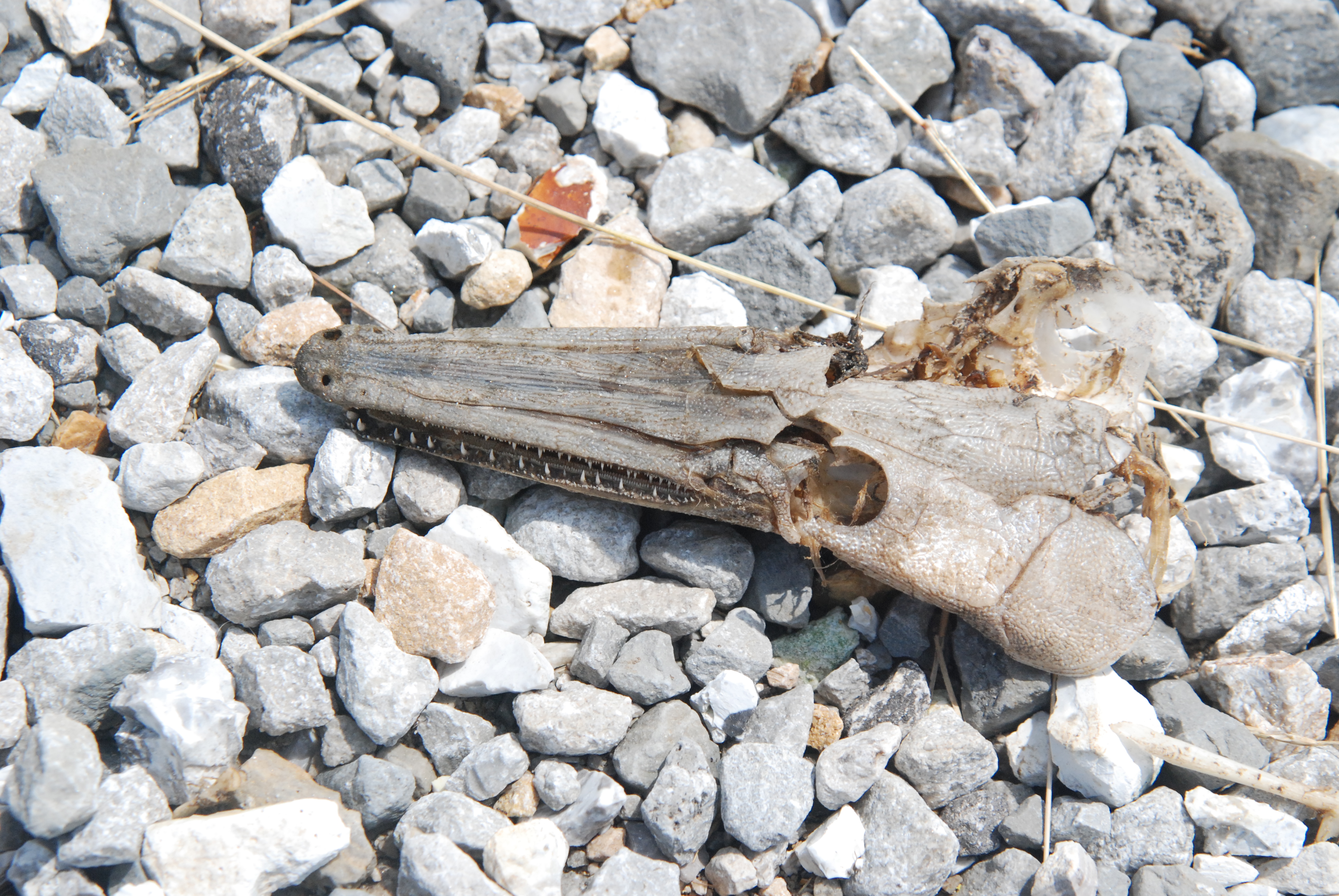
Like Jay-Z’s Jesus piece, central Missouri is flooded. And when the water recedes, it leaves behind the unseen world of the river bottom. Case in point: this toothy fish.

DSC_5402
And another picture, with a 20 oz soda bottle for size comparison:
DSC_5403
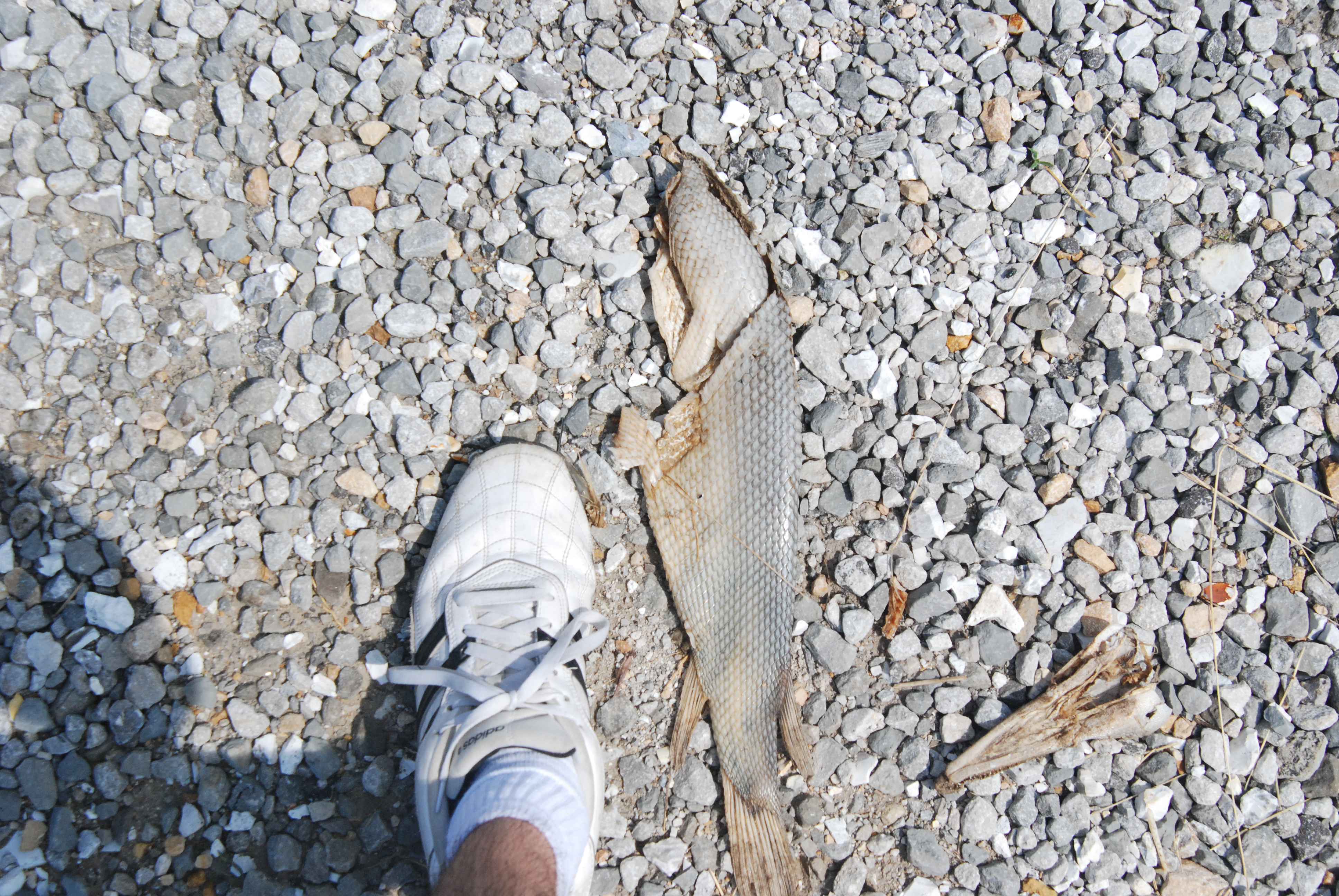
So while this skull belonged to no killer, it definitely makes me thinks twice about jumping in Perche Creek just off Providence Road, where I found this skull. A fish body was nearby (picture taken with my foot for scale, I’m a gentlemen’s size 12, which is roughly an actual foot):
DSC_5401
As close as the two pieces were, my journalistic integrity prevents me saying that this skull, which was missing a body, is from that body, which was missing a skull. But they were close. 
Perche Creek,  a tributary of the Missouri River, was high but not flooding it’s banks when I was taking pictures last week.
DSC_5414
DSC_5407
With all the rain and flooding since this picture was taken, I’m curious to see what has washed up since.  I would strongly encourage the curious to don some old shoes and walk a riverbank after the water recedes.